Guides
The Hidden Cost of Price Inconsistency
True pricing discipline reflects quality, standards, and long-term positioning. We examine why structured pricing builds trust while volatility quietly weakens it.
Written by Dominum Gladii Editorial
Research & Standards
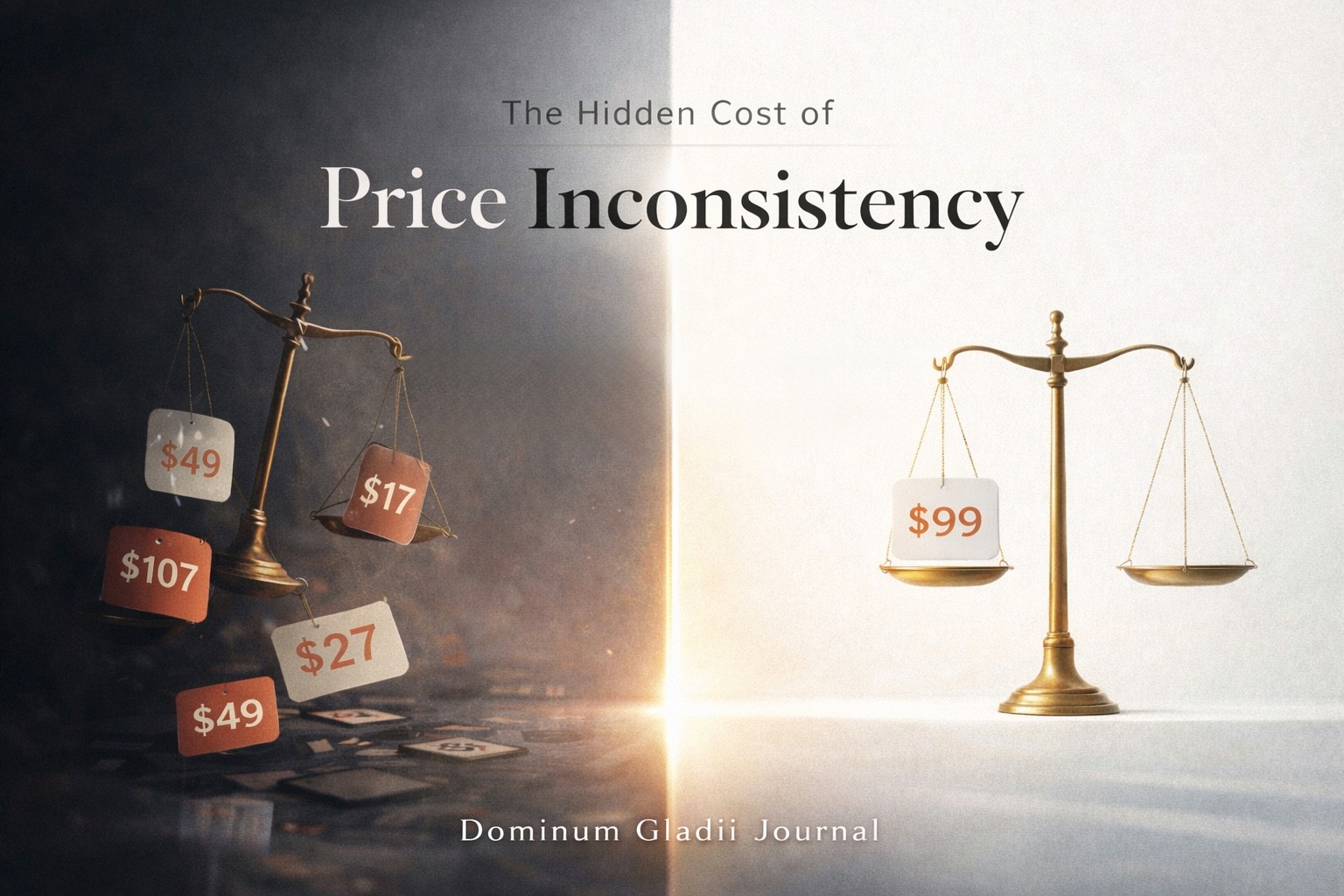
The Hidden Cost of Price Inconsistency
Price is not only a number.
It is a signal.
It communicates positioning.
It communicates quality.
It communicates confidence.
When pricing lacks structure, those signals weaken.
Volatility Creates Uncertainty
Frequent price shifts may increase short-term activity.
Flash discounts.
Sudden markups.
Dynamic adjustments without clear rationale.
But over time, inconsistency introduces doubt.
Customers begin to ask:
Was the previous price inflated?
Is this discount artificial?
Will the price change again tomorrow?
When uncertainty replaces clarity, trust declines.
Discount Cycles and Perceived Value
Constant promotions train buyers to wait.
If prices fluctuate regularly, the stated value of a product becomes unstable.
The product is no longer evaluated on quality.
It is evaluated on timing.
This shifts attention away from craftsmanship and toward opportunity.
Over time, perceived value erodes.
Structured Pricing Reflects Standards
Pricing discipline is not rigidity.
It is alignment.
When price reflects:
• Consistent quality
• Transparent positioning
• Long-term strategy
• Measured margins
Confidence becomes natural.
Customers understand what they are paying for.
And why.
Stability signals conviction.
Conviction signals integrity.
The Relationship Between Price and Trust
Trust compounds slowly.
It is reinforced through consistency.
When pricing remains coherent across time, platforms, and contexts, the experience feels predictable.
Predictability reduces friction.
Reduced friction strengthens loyalty.
Volatility, even when well-intentioned, introduces instability.
And instability weakens trust quietly.
Long-Term Positioning
Structured pricing reflects long-term thinking.
It prioritizes:
• Reputation over urgency
• Value over impulse
• Alignment over manipulation
It removes the need for constant negotiation.
It replaces reactive adjustments with deliberate positioning.
And deliberate positioning endures.