Productivity
The Hidden Cost of Too Many Options
An excess of choice increases cognitive load, weakens focus, and erodes the quality of your decisions.
Written by Dominum Gladii Editorial
Research & Standards

The Hidden Cost of Too Many Options
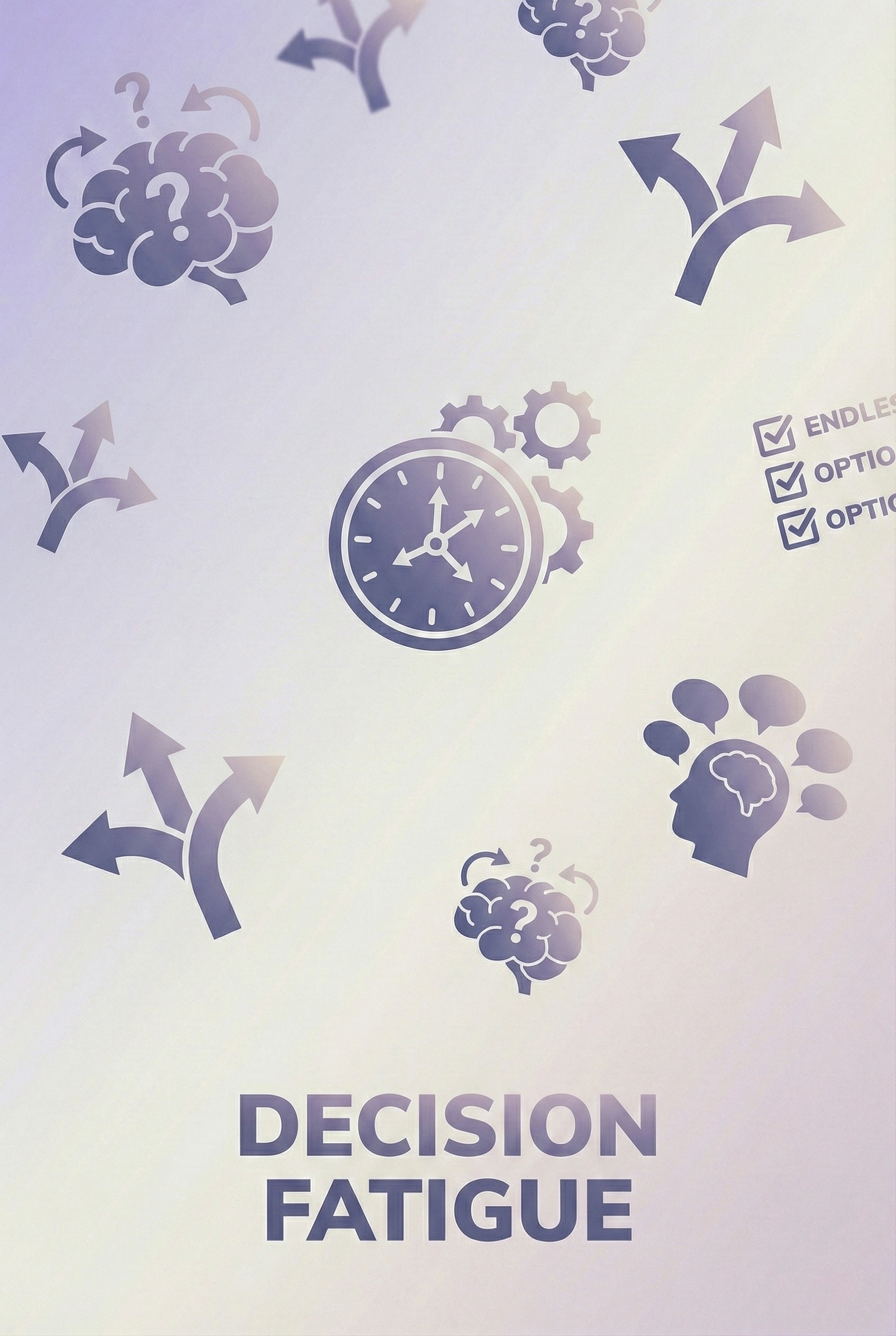
More Is Not Neutral
Choice is often framed as a benefit.
More features.
More brands.
More variations.
It appears empowering.
But choice is not neutral. Every additional option requires evaluation. And evaluation consumes cognitive resources.
When options multiply without structure, the cost is not visible immediately. It accumulates quietly.
Focus declines.
Decisions slow down.
Confidence weakens.
The damage is subtle but measurable.
Cognitive Load Is Finite
The human brain does not operate with unlimited processing capacity.
Every comparison requires attention.
Every review requires interpretation.
Every price difference demands justification.
Multiply that across dozens of options and the cognitive load increases exponentially.
The result is not better decisions.
It is hesitation.
And hesitation reduces productivity in every domain, not only shopping.
Decision Fatigue Extends Beyond Commerce
The impact of excessive choice does not end at checkout.
When mental energy is spent navigating unnecessary complexity, fewer resources remain for higher-value decisions.
Work slows.
Clarity diminishes.
Priorities blur.
Productivity is not only about time management. It is about preserving cognitive bandwidth.
Too many options consume it.
The Illusion of Optimization
Many believe that reviewing more options leads to better outcomes.
In reality, beyond a certain threshold, performance declines.
When evaluation becomes excessive:
• Satisfaction decreases
• Doubt increases
• Post-purchase regret rises
• Follow-through weakens
Abundance creates the illusion of optimization while quietly undermining it.